Comprising a 11,300km network of shepherding paths, alpine passages, and old byways, the SLT makes a staggering continuous traversal of the world's greatest ranges. From the subtropical lowlands of eastern Nepal to the windswept void of the Karakorum icefield, the trail corridor experiences a broader diversity of climate and ecosystem conditions than seen along any other trek worldwide.
"To preserve the rich ecological wealth of the Himalayan - Tian Shan belt on behalf of the shepherds and leopards who call the region home."
The Snow Leopard Track is a visionary 15,000km network of alpine trails uniting Nepal with Kyrgyzstan, created by a group of intrepid world explorers. This collective has sought to unravel the most spectacular, wild passages through the terrain therein.
Along its course it ranges through desolate high-altitude deserts, penetrates dense subtropical rainforests, traverses vast icefields and steppe, follows meandering waterways, and crosses verdant alpine pastures. Our ethos favors routes that are unspoiled over those that are direct.
Like the eponymous snow leopards from whom this route derives its inspiration, we are committed, perhaps relegated, to the highest attainable places.
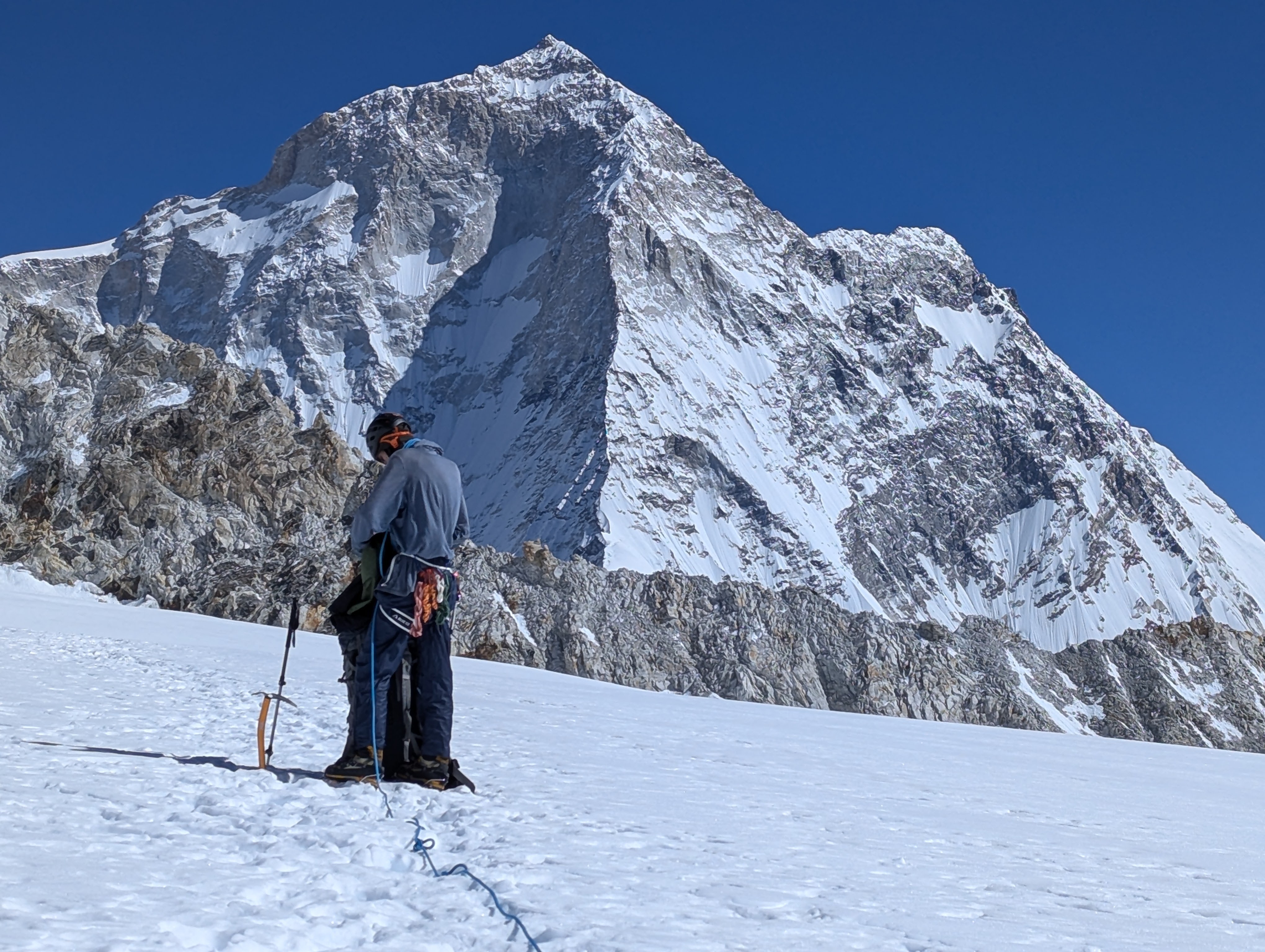
We are a team of alpinists, writers, and cartographers committed to exploring the world's most remote corners. The Snow Leopard Track is our flagship initiative, and in 2026 we are assembling a team of explorers to explore select sections of the route.
Essential information for aspiring thru-hikers.
No. The Snow Leopard Track is a conceptual route. While it links existing shepherd trails and old trade routes, vast sections (especially in Tajikistan and Pakistan) are cross-country and require advanced navigation skills. Not a single kilometer of it is formally waymarked, yet at the time of writing (Jan 2026) more than 70% of it has been personally confirmed to be traversable by the founder, Ian Roth, and co.
Absolutely. You will typically need standard visas for all 6 countries. The time, effort, and cost investment for this which will vary greatly from one country to the next, and depending on your citizenship. Furthermore, specific border zone permits (GBAO in Tajikistan, Border Zone Permits in Kyrgyzstan, Restricted Area Permits in Nepal, NOC in Pakistan etc., are required for legal passage through select regions. Pakistan and Nepal are particularly congested with bureaucratic bloat, and while it is tentatively possible to transgress some of these regulations, and many of them on the ground tend to be 'interprative,' *it is not recommended to do so.* Begin preparation at least 6 months in advance.
The window varies wildly from south to north and between regions, but generally favors a northbound orientation. In Nepal, the prime season usually runs from March through May and from October through November, with shoulder seasons experiencing severe cold or heavy monsoonal rain. The Indian Himalaya reflects this, but the season is shifed somewhat closer to a conventional northern hemisphere summer, as the monsoon effect is generally tamer than in Nepal while the winters are earlier and more severe. The Trans-Himalaya around Ladakh and Kashmir experience a markedly more continental climate, with the prime season running from June to September. Across Pakistan, Afghanistan, and Tajikistan the season imroves as summer progresses.The window for the high Karakorum is especially short, and the icefields are typically only navigable between July and August. Tajikistan, on the other hand, enjoys a dry, cold September and October, and many of the wild rivers there are only passable in these two months. Kyrgyzstan and Kazakhstan exist just outside the scope of this trend, and the season in the Tian Shan and Alay is as long as the region is diverse. Conveniently, the south begins melting out as early as late May, while the north peaks around August. The high passes are generally snow-free until mid to late September.
Reliable paper maps are scarcely available for much of the route outside Nepal. A GPX-compatible device with pre-loaded tracks is mandatory. Contact Us for more info on this matter. You must be proficient in reading terrain and off-trail navigation, as physical paths frequently disappear in landslide zones, meadows, brambles, and glacial moraines. (While the map resource provided here offers detailed descriptions of each route segment, significantly more detailed GPX models exist, available upon request.)
Yes. Because it seeks to remain as remote and high as possible, the core route involves crossing numerous glacial passes. A minimalist alpine rack, and the knowledge on how to employ this, are crucial to safely completing the core trail . While care was taken to balance reasonable difficulty with the most spectacular routes, nothing about this trail is light. It is undoubtedly the most difficult thru-hike in the world. That said, for those without partners or technical foreknowledge, an alternative low route exists, thought this often exchanges technical difficulty with routefinding difficulty, or an increase in overall vertical. Alternatively, for those who want to get high but lack the knowledge, many technical sections can be tackled with the aid of skilled mountain guides - most notably those in Pakistan and Nepal. As a sidenote, many stretches of river in Central Asia are prime for packrafting. This opens up exciting and efficient possibilities.
Resupply points are generally far apart. Expect to carry 8-10 days of food regularly. More often, the most reliable resupply is in the nearest large city. In Nepal, it is possible to pay a guide to deliver food to key points along the trail. In India and Pakistan, food is widely available in minor cities along the route. Afghanistan can be done in a single push. For Tajkistan I recommend buying everything one needs in Dushanbe, then staging out of Khorog for each section. Between Kyrgyzstan and Kazakhstan the key resupply cities, in order from south to north, are: Batken, Osh, Bishkek, Almaty, and Karakol.
It is almost assured that you will break bread with shepherds regularly throughout the trail. Hospitality is a commonality across nearly all of the mountainous regions of South and Central Asia. Unsurprisingly, many hosts will balk at any gestures of payment, but mutual exchanges of goodwill are usually eagerly met.
While alway possible, it is unlikely. They are the "Ghosts of the Mountains" for a reason, and this elusivity is what lends them such a legendary status amongst mammals. That said, you will be walking directly through their prime habitat for months, hence the name of the trail, and you will almost certainly see some signs - scat, scrapes, and prints. Beyond this, other wildlife such as argali, ibex, Himalayan brown bears, Asiatic black bears, pallas cat, steppe wolves, Eurasian lynx, and many more abound.
The full traverse, in practice, consists of numerous consecutive expeditions. Any of these could be considered a strong effort on its own, but when strung together they become what is undoubtedly the hardest "trail" on earth. The average gradient is more than double that of the PCT, the resupply intervals much greater, and the absolute elevation is very high. Public transport, borders, and heavy carries hinder a swift, fluid thru. Theoretically, with bombproof logistics and an iron will, a trekker could complete the entire traverse, south to north, in approximately 2 seasons.
Dedicate a minimum of 3 months to Nepal, from March through May, then quickly migrate to Uttarkhand and work north through India from June through August. Between August and September, crack away at the Karakorum in Pakistan before the high passes snow in. The next season would commence in southern Kyrgyzstan, and work northward through August before jumpng back to conclude with the Pamir spanning Tajikistan and Afghanistan. Realistically, it is more practical to segment hike portions of the trail, rather than attempt the whole route, as this ensures one experiences each region during its optimal season.
Sidebar
Fullscreen
Reset
Back / Close